What changed in each build sent to Steam, newest first.
Sorcerers' Arena in the spotlight and the seven crafts of Velmora
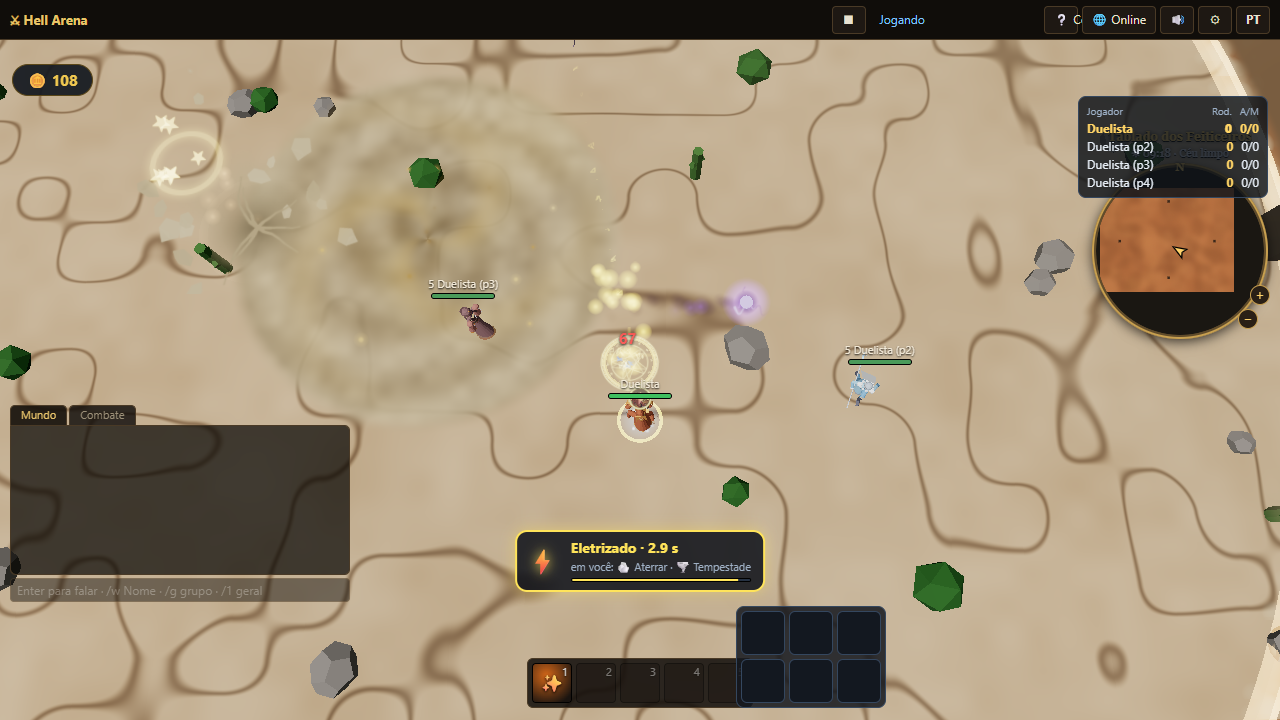
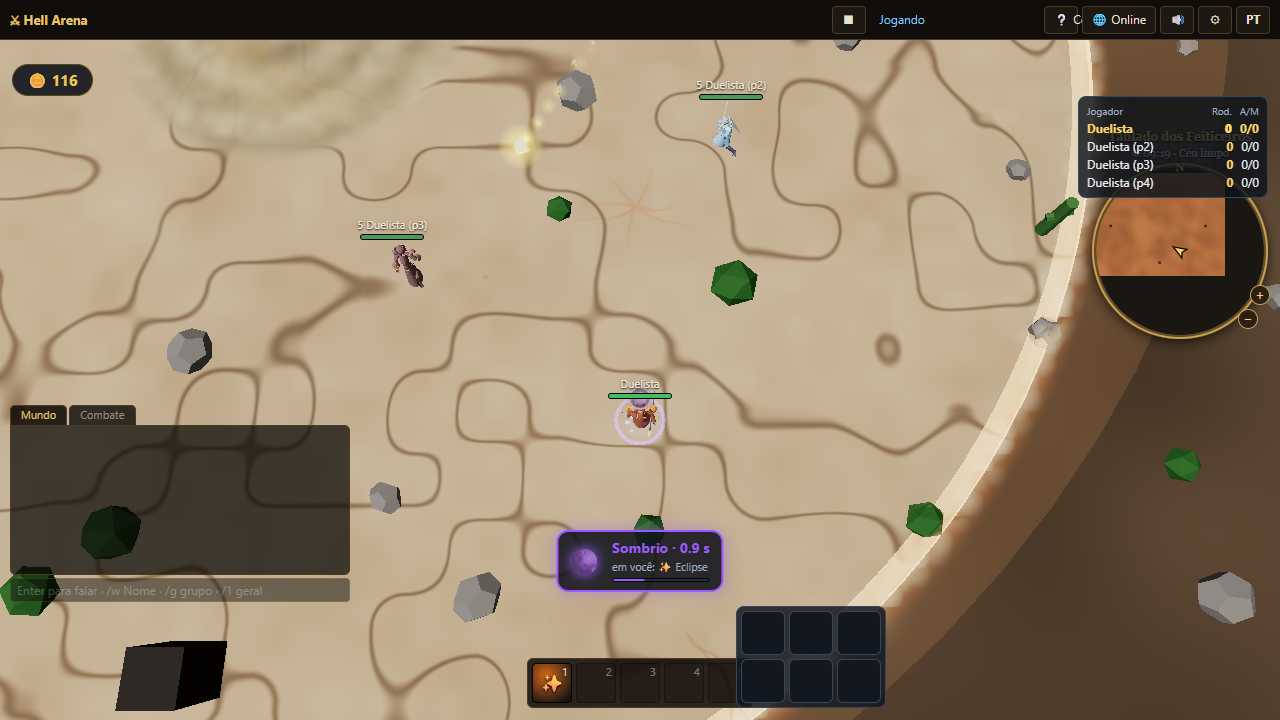
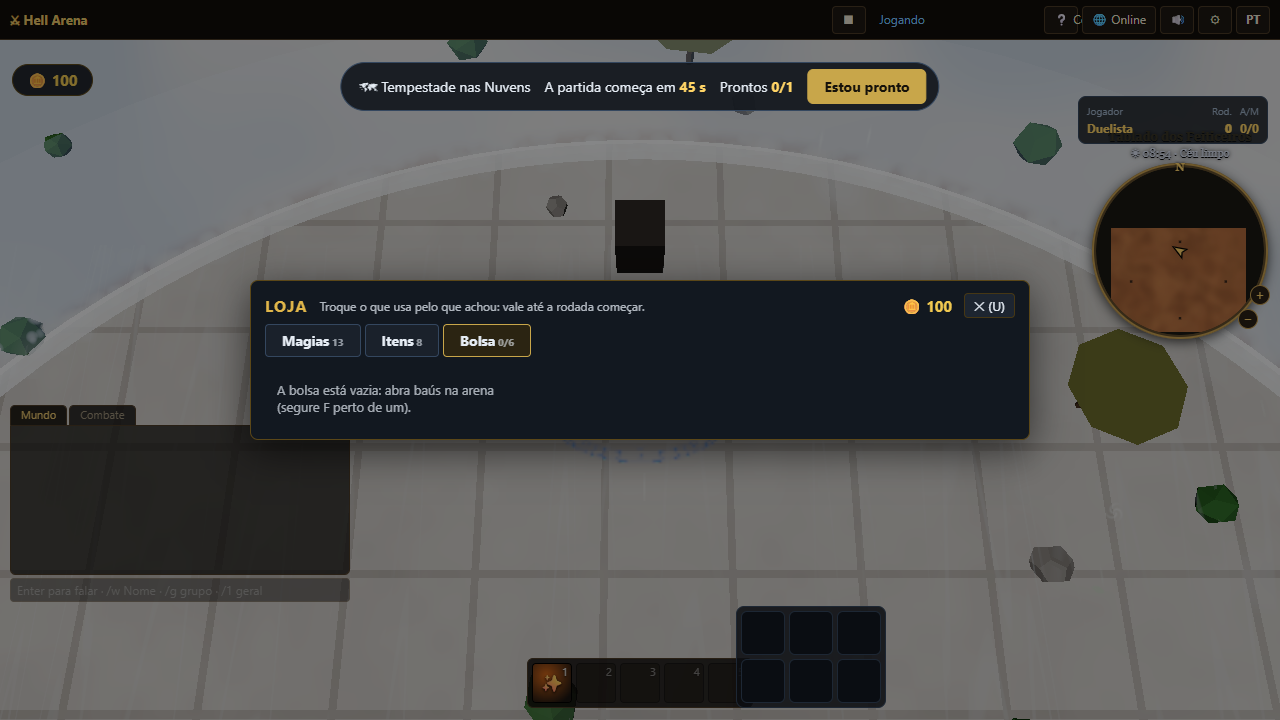
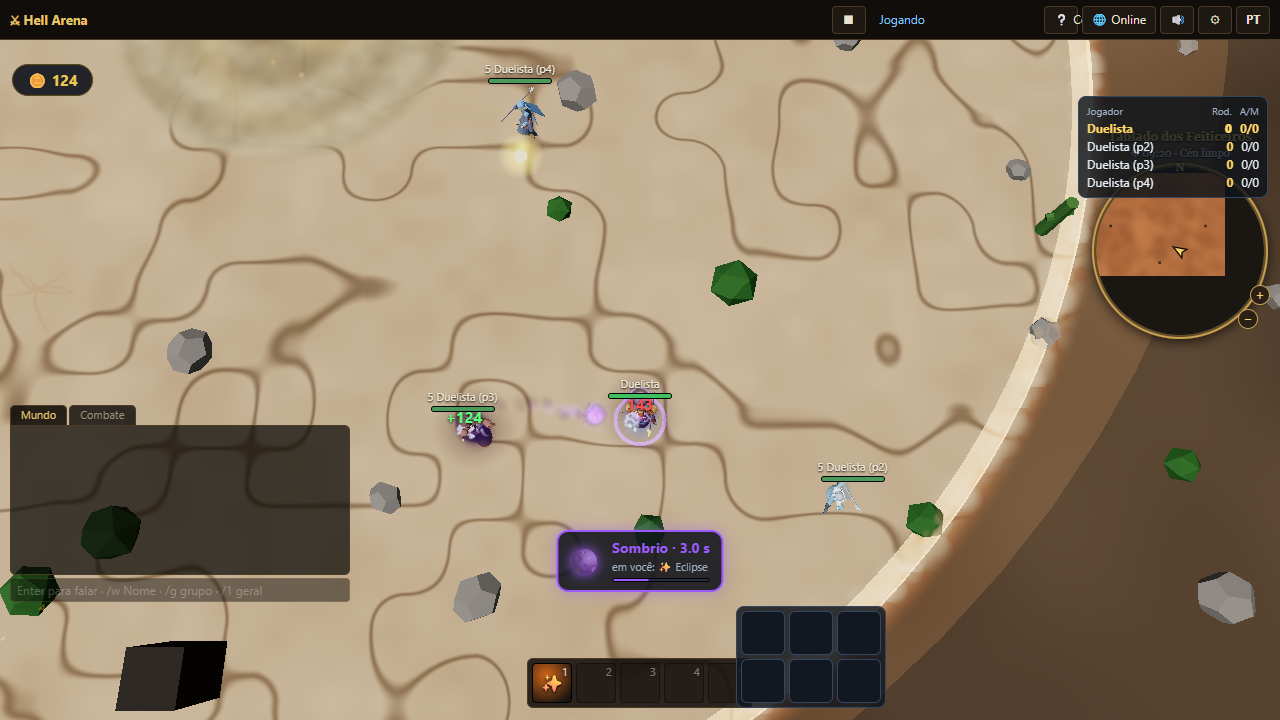
Sorcerers' Arena: it now has its own highlighted card in the world list, and its table fills the screen. Play in duos, trios or quartets: at the table each player takes a place on the side they want, and empty places are bots. Your own name (your Steam name on Steam) shows on the scoreboard and in the match. Every spell has its own sound, and the ground's strikes, the whirlwinds, lava and water, buffs and debuffs and the chests now have sound too.
Seven crafts of Velmora: Embersmithing, Woodcraft, Apothecary, Cocoon Weaving, Clockwork, Runescribing and the new Cartography. Each one gathers, makes and has its own role: forging by the lava gives more Masterwork but the Ember may eat the piece, the woodsman sees the rares on the minimap, the apothecary's salves clear poisons, curses and binding spells, the weaver's net holds enemies and the shroud hides you, the cartographer finds map fragments and sees every vein and herb.
A new character picks two crafts along with the class. You can swap one later, but it starts again from zero.
Sorcerers' Arena: the arena is reborn
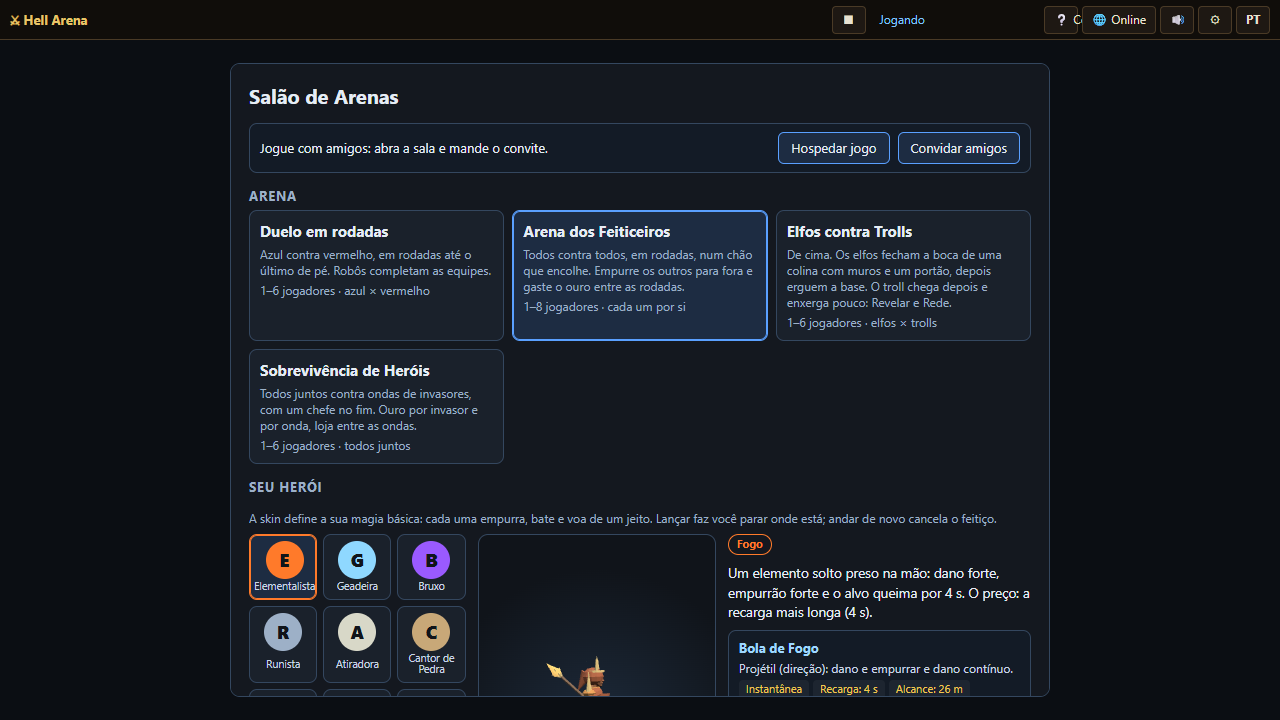
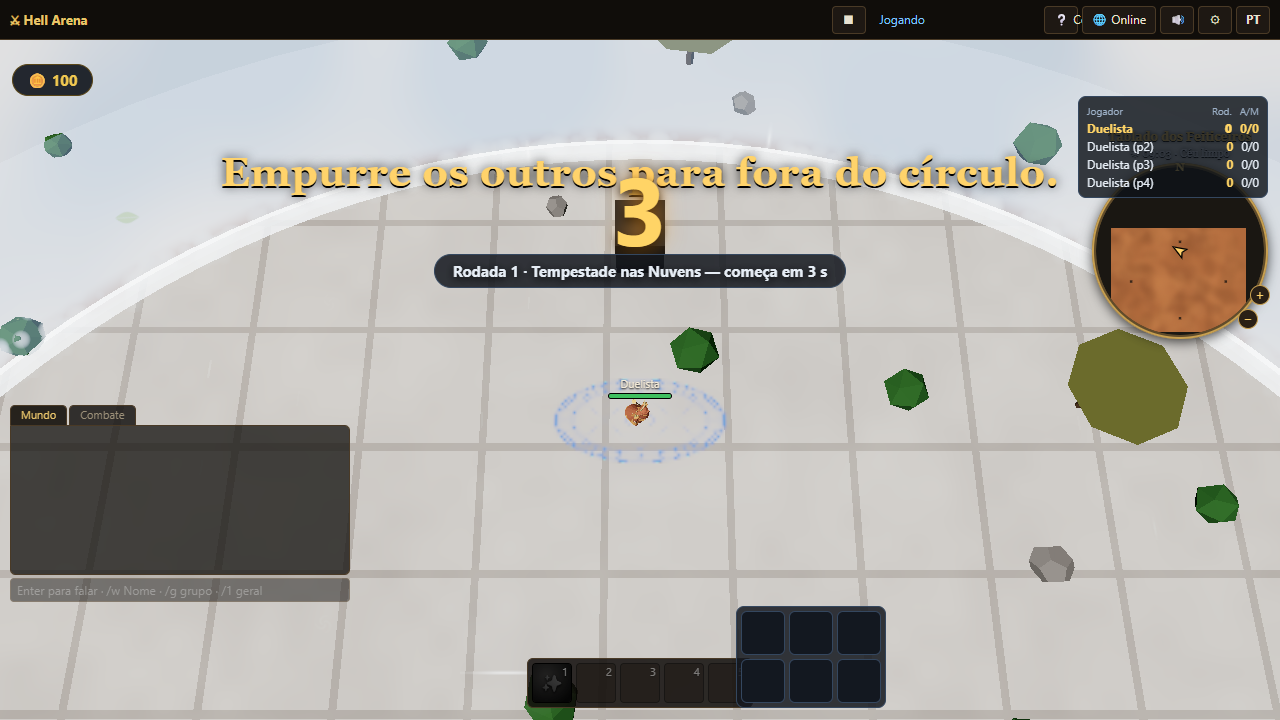
Everyone against everyone, on a floor that shrinks and catches fire. Every spell pushes, every round counts, and the last one standing takes it. The Sorcerers' Arena now has heroes with their own magic, twelve living scenarios, elements that combine, a shop full of risky choices, chests hidden in the middle of the fight and online matches with your friends.
Pick your sorcerer
At the arena table each player picks their own hero, watching the body turn in 3D and seeing what its spell does. There are eleven sorcerers, and each one's first spell is instant and different: fire hurts and pushes the most but takes long to come back; frost barely pushes but slows the target; shadow pushes like nothing else but costs a bit of your life; the arrow reaches farthest; stone pins the target where it lands; water drags it away and shields you; nature heals an ally. Everything fires at once, no cast bar: your aim decides.
A tutorial that shows instead of telling
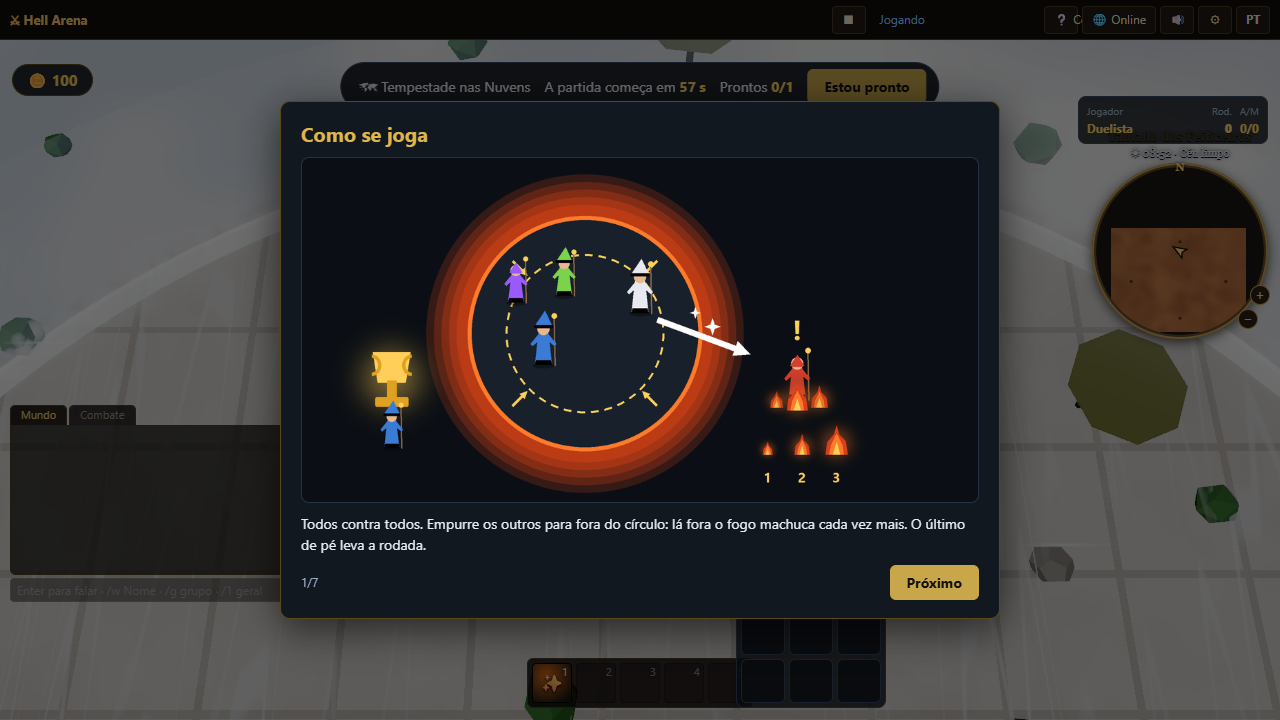
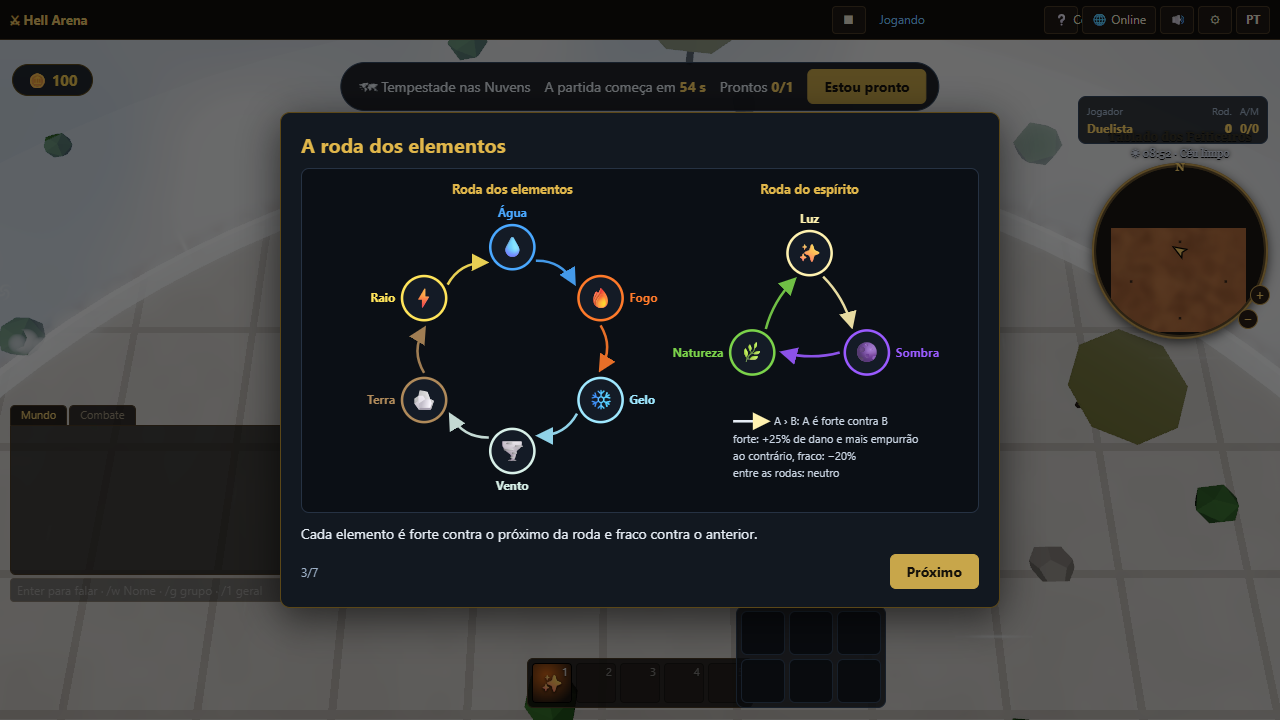
Before the first round, seven short illustrated pages teach the essentials: how to win, the controls, the wheel of the elements, the combos, the ground that fights too, and how the shop works. One minute to read, and you go in knowing what to do.
Elements and combos
Every spell has an element and leaves a mark on its target for a few seconds. Each element is strong against the next one on the wheel and weak against the one before, and hitting a marked target with the right element sets off a combo: fire on someone Chilled melts them for double damage, lightning on someone Wet paralyses them, wind on someone Burning spreads the fire to whoever is near. Every combo has its price, and there are many more to discover.
Twelve living scenarios
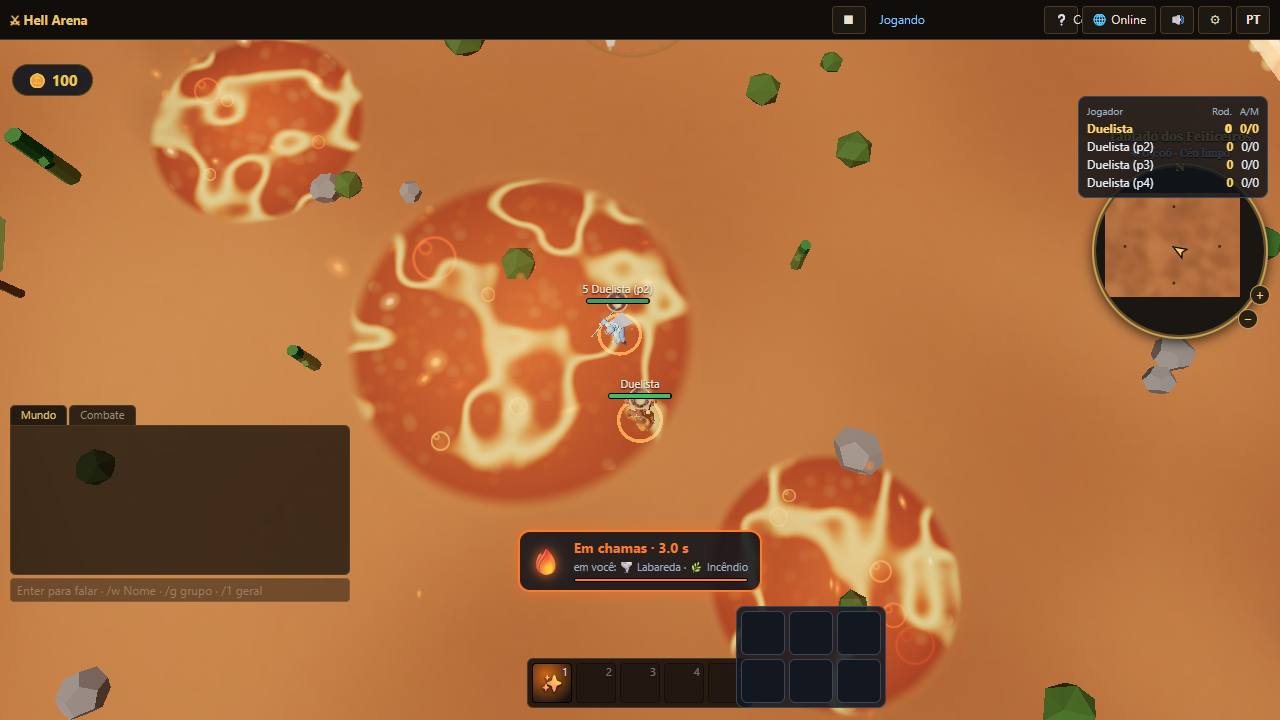
Each match is played in a scenario of one element, and the floor itself is a weapon. In the Volcano and the Caldera the lava burns more the longer you stand in it; on the Isle of Winds and in the Storm in the Clouds gusts push everyone one way and lightning seeks whoever stands still; in the Deep Lake and the Rough Tide water slows you and the current carries you off; on the Glacier and in the Blizzard ice slides and pushes go farther; in the Gorge and the Stone Mill rocks fall and a blade sweeps the floor; in the Swamp and the Mushroom Garden quicksand holds your feet and mushrooms throw whoever touches them. The ground marks where it will strike before it lands, so whoever pays attention gets away, and whoever pushes someone in gets the kill. The host picks the scenario by name, or lets it be drawn.
The ring of fire
The safe floor shrinks every round. Outside the ring, two seconds still give you time to come back; after that the fire grows fast and three seconds out there bring anyone down. Pushing someone out at the end of a round is the sweetest play in the arena.
Knockbacks with weight
Getting pushed now has real physics: the body shoots off at the blow and slows down to a stop. At the table the host picks one of five ways to fly: Impact, Linear, Slide (as on ice), Whip (gathers speed and brakes) and Bounce (hits the wall and comes back). Try them and see which suits your group.
The shop: power at a price
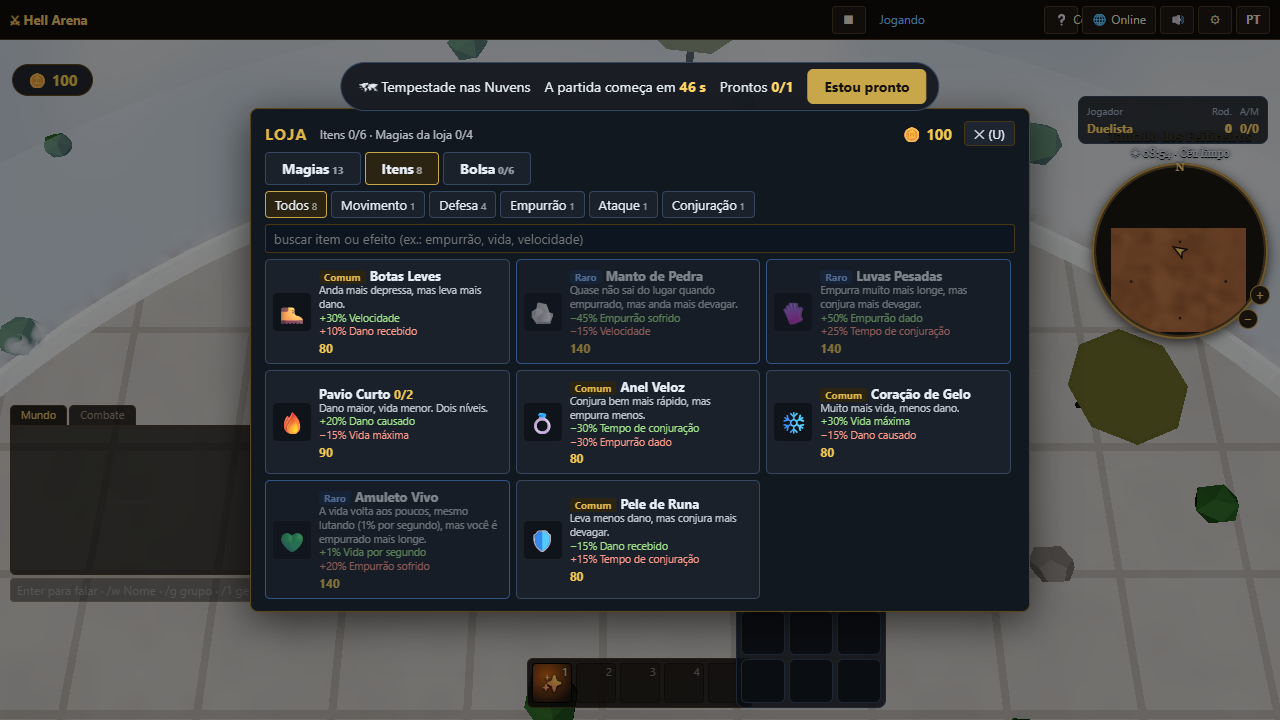
You earn gold by landing hits, helping, taking players down and winning rounds, and you spend it between them. The shop is split into Spells and Items. Items give power with a risk: boots that speed you up but leave you more fragile, gloves that push harder but slow your casting, an amulet that heals over time but makes you fly farther. There are six item slots. Spells range from the Arcane Barrier to the Meteor Shower, by rarity, with up to four on your bar.
Chests in the middle of the fight
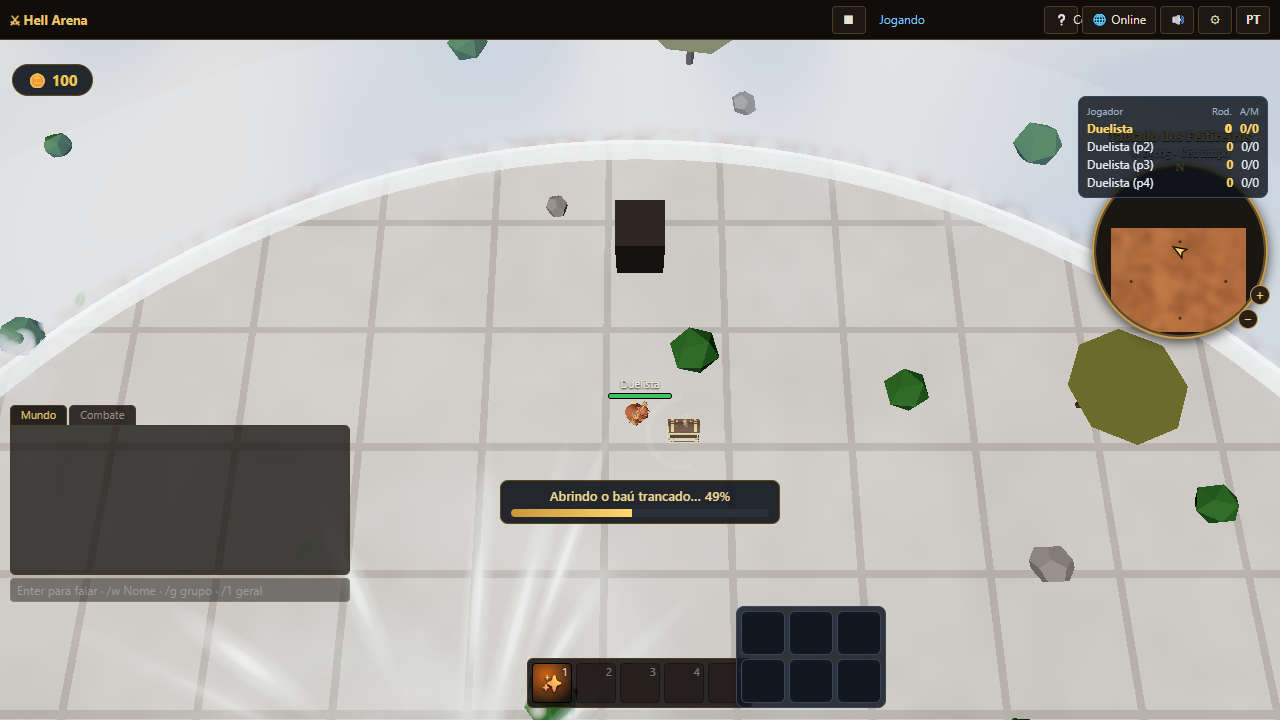
During the round, chests show up in the arena. Hold F by one for five seconds, without moving and without taking damage, and it opens: gold and sometimes a piece of shop gear, which goes into your match bag. Between rounds, swap what you found for what you wear. Some chests come locked: they only open with a key (which sometimes drops from a plain chest) and hold much better things. Stopping to open a chest with others nearby is a gamble.
The winner's vault
Whoever wins the match takes home everything they wear and everything in their bag, keys too, into a vault of their own. Before the next match, pick up to six of those items at the table to bring in. But careful: only the winner keeps what they brought. Whoever loses, loses what they risked.
Rounds, scoreboard and spectating
Rounds start with everyone at their own spot, full life and held still until the start, while the shop is open. Hold Tab to see the whole scoreboard (rounds, kills, deaths and gold of each player); a small one always sits in the corner. Fell? Watch the rest of the round: WASD moves the camera and Space goes from one player to the next. Nobody sees on the ground where the others are aiming, so reading your opponent is worth gold.
Online with your friends
At the table, the Host game button opens the room online and shows its code; Invite friends calls whoever is on your Steam list. The match runs on a direct connection between the players: the host picks the arena, the scenario and the rules, and each friend picks their own hero. The places left over go to bots, in three difficulties, that spread their attacks instead of hunting only you.
Tuning and fixes
• Sorcerers' Arena: casting a spell while walking now stops you and casts toward the mouse; with the aim preview you keep walking while aiming and the click stops and casts.
• Sorcerers' Arena: the basic spell only waits for the global cooldown, and the shop spells recharge much faster.
• Sorcerers' Arena: 30 seconds between rounds to shop, or less when everyone says ready; every round starts with full life at each player's own spot.
• Sorcerers' Arena: the enemies' cast bars are hidden, and the ring's edge burns with real fire.
• Arenas: the match tutorial no longer opens over the controls card, the shop no longer reopens after you say ready, and the ready button always takes the click.
• Sorcerers' Arena: everyone has less life and it no longer comes back by itself; only the new Living Amulet in the shop heals over time.
• Sorcerers' Arena: the ring's fire gets worse the longer you burn in it.
Hero Arena: the Golem Forge, brush ambushes and much more
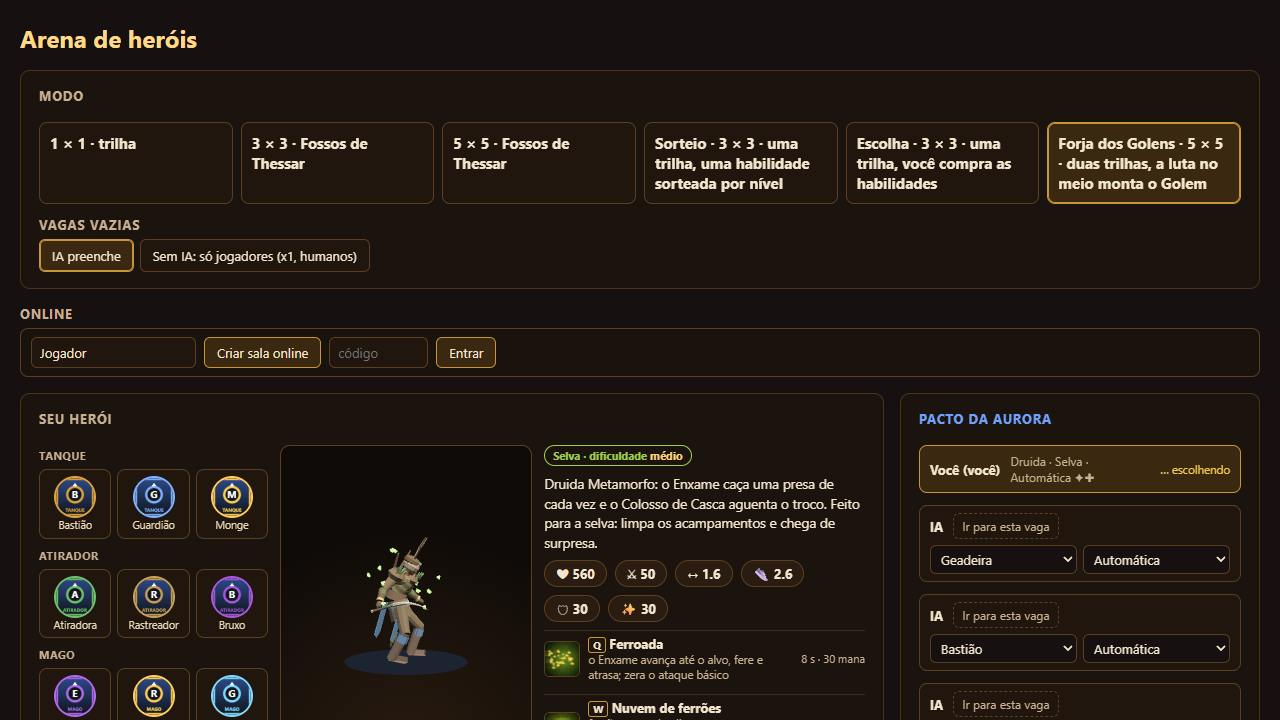
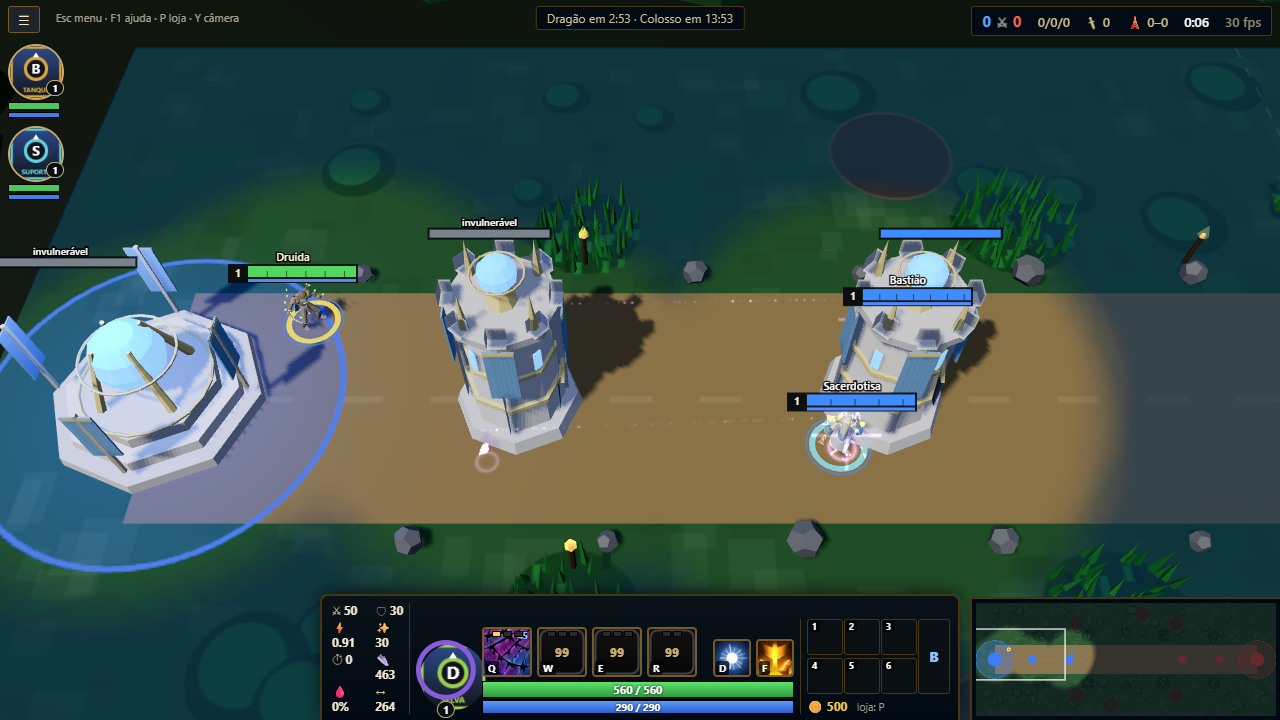
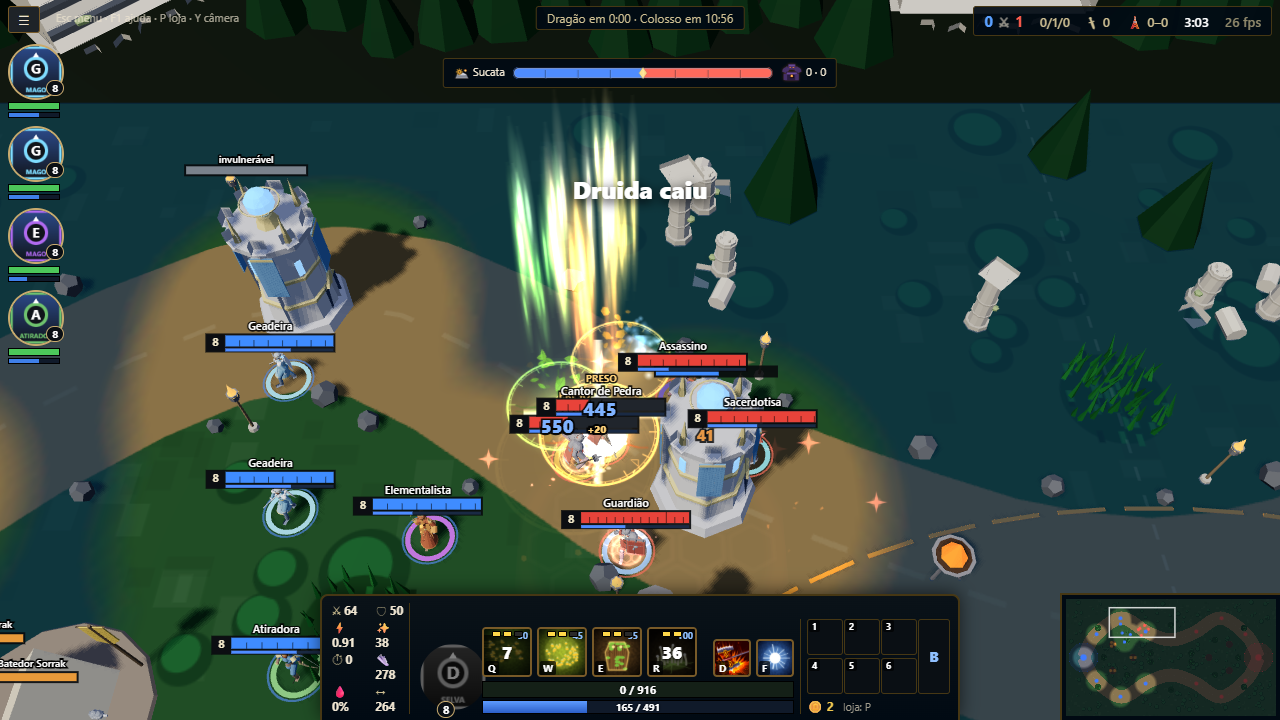
The Hero Arena has grown: a new map with a mechanic of its own, mercenaries, ambush brush, 15 heroes and two ability modes. Here is what changed and what it feels like to play.
The Golem Forge: a brand-new map
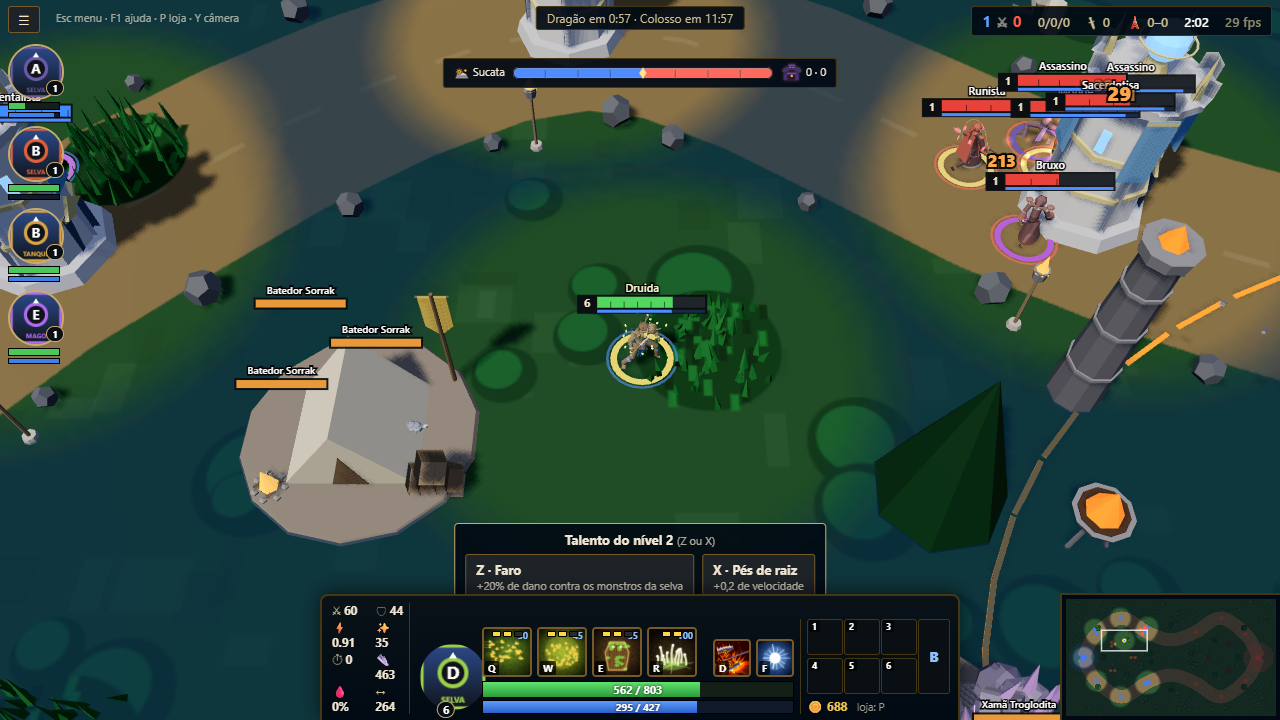
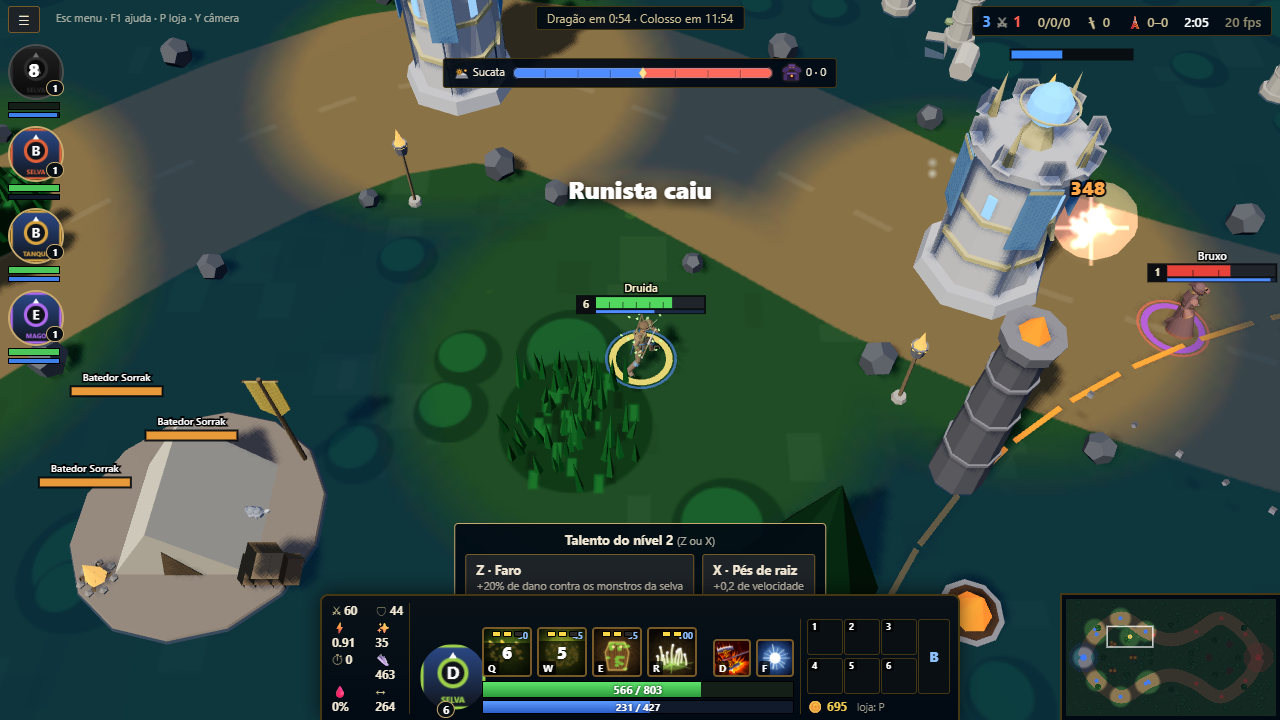
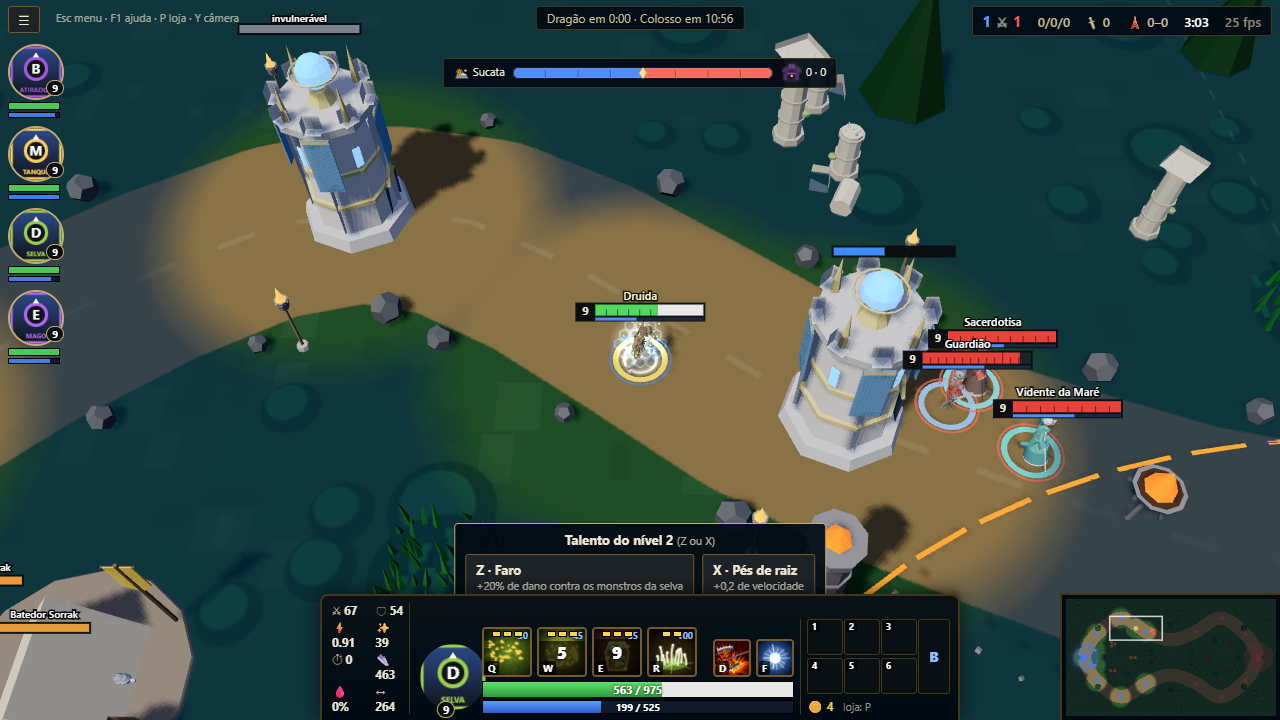
The new map has two wide lanes, 5 versus 5, in the Obsidian Slopes. The Forge sits in the middle: everything that dies inside it (minions, mercenaries, monsters and heroes) becomes scrap for the team that killed it. The meter at the top of the screen leans toward whoever controls the center and, when it fills, that team assembles an Obsidian Golem that marches down a lane and tears down towers for 70 seconds. The team that is behind can still deny it: just keep fighting under the forge. The forge is built up stage by stage as the meter rises, and each team sees it glow in its own color.
Mercenaries and camps
Six camps of Velmora's peoples (Sorrak Spearmen, Red Tower Spitters and Troglodytes) are spread across the map. Defeat one and the band fights for you: spearmen and spitters wipe out enemy waves, and the Troglodytes go after structures. Each camp has its own set dressing, and jungle monsters now come one at a time: pull one and the others stay home.
Brush and ambushes
Step into the brush and you vanish from the enemy's sight. Wait for your opponent to walk by, pop out by surprise and unleash your combo: the ambush is now a real play, and the AI heroes know how to use it too. When an AI comes to gank, it heads back to its own lane as soon as the play works (or fails) instead of staying to steal your minions.
New heroes and the Druid
There are now 15 heroes, three per role (tank, marksman, mage, support and jungler), all with names and stories from Velmora. The Shapeshifter Druid is the jungle hunter: the Swarm chases one prey at a time, the Stinger Cloud clears a whole camp and the Bark Colossus turns into trunk and moss for 3 seconds, with a shield that absorbs damage. Only heroes with a jungle kit go to the jungle.
Draw and Pick
Two new 3 versus 3 modes on a single lane. In Draw, every level gives you a random ability: every match is different, and ultimates show up from level 5. In Pick, you open an ability shop sorted by category, with search by name, and buy the ones you want; level each one up by clicking the + or the learn key. The library holds hundreds of abilities.
Abilities, particles and camera
Every ability has its own particles, in the color of its school (arcane is purple, fire is orange, nature is green) and aimed where you aim: shields, projectiles and waves point the right way. When a minion falls, only the +gold and +XP of whoever earned it pops up: no explosion on every death. There are options for graphics quality, the locked camera (Y) and the free camera (space recenters).
Shop, scoreboard and match
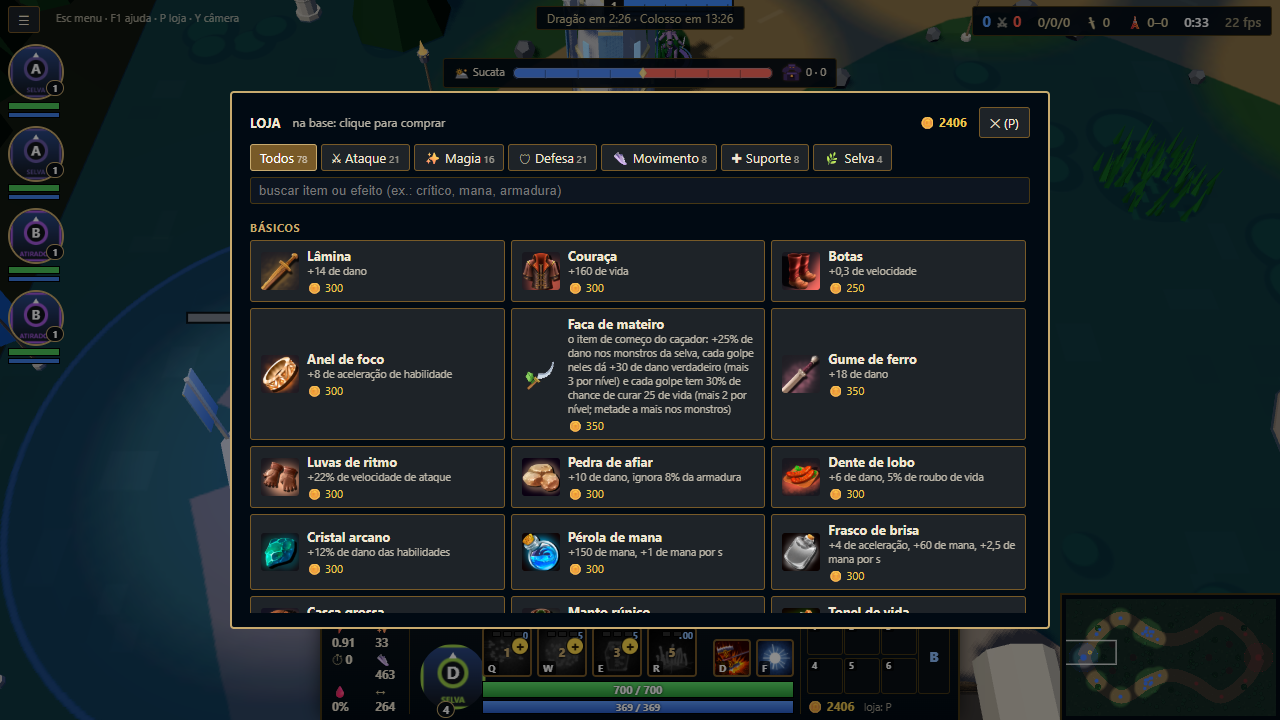
The shop has 78 items shelved by type (attack, magic, defense, movement, support and jungle), with search by name or effect, usable items on their own keys and rebindable hotkeys. Hold Tab to see the scoreboard, without the enemy team's picks. In the lobby you choose your hero, your pair of summoner spells and, if you want, play with no AI filling the empty slots, for a one-on-one or just among friends.
Tower defense upgrades, a base pack for creators, world interface layouts and more forms in the workshops
Sorcerers' Arena: each skin now comes with its own basic spell — a projectile that hurts and pushes in its own way (fire hits hardest, ice is fast and slows, the shadow orb and the tide push far, the arrow shoots most often, the thorn roots) — and the table says what each does. The skins are the heroes of the hero arena and the RPG figures. The bots play like heroes: they keep their distance, zigzag, lead their shots and step out of the way of yours, and have no melee. The arena is played in 3D, and the options show only what belongs to it.
Tower defense: dragging the field with the left mouse button no longer shakes the view; it now moves smoothly, the same way as the movement keys (WASD and the arrows).
Tower defense: the towers' hits are no longer all lasers. The Ember Catapult lobs a burning rock that bursts into flying debris where it lands, the ice towers throw an ice lance that leaves a frosty trail and ice spikes on impact, the lightning pillar gathers a glowing light over itself while it reloads and then strikes with a bolt from the sky, the Ember Breath spits a stream of flame, and the Spear of Light pierces with a long streak. Creators can pick the look of each tower in the World Workshop.
Tower defense: the defense demo now starts in 3D (the 2D is still a choice), with a grid on the ground showing where towers can go. In 3D the towers now show their real models instead of dark boxes. On Medium and Hard the ground you can build on comes in fewer patches, so where each tower goes matters. The "Call now" button works again.
Custom arenas: a new arena, Elves against Trolls (strategy), seen from above. The elves start with nothing: they run to a hill with one or two mouths, close each mouth with walls and a single gate (only the elves pass it), and only then raise the base that trains miners and lumberjacks; the rest (storage, mining camp, sawmill, towers, healing fountain) opens after the base. Walls, gate and towers go up in tiers to hold the troll. The troll arrives later from its lair, which brings gold every few seconds and can be upgraded; it sees only what is near, has two skills — Reveal (lights an area) and Net (traps whoever is in the circle) — earns gold for every blow on a wall, a structure or an elf, and spends it on gear, scrolls and talents in a shop like the heroes' arena shop. The elves lose if the base falls and win by holding out the time. Both sides buy from the same kind of shop, with tabs and cards.
Tower defense: towers can now be upgraded along separate paths (damage, reach, rate of fire or area), up to five levels each, and some towers have a cap so you cannot max everything; the Crossbow and the Ember Catapult now have five levels before their branches. In 2D the towers now look like the 3D ones: a pillar with a turning head whose colour changes as it levels up. In 3D the tower heads now face their target.
World Workshop: a world sets up its own screen. Up to four action bars with their own number of buttons, buttons per row, corner, size, title and spells already on them; where each piece of the screen sits (frames, cast bar, map, chat, objectives, boss bar, score bar) and its size; and counters that show a value of the rules (lives, laps, time left, score) as a number, a clock or a bar.
Kart in the race garage, tower defense weather, side-view feel, wounds and a leaner world list
The world list keeps the games worth playing: MOBA, Expedition, Chemistry, the two side-view games (Shot and Crypt), Race (with Kart inside), Basketball, Defense, Tower Duel and Arenas.
Community worlds in 3D: the body shows how it is. A hurt leg limps and stands on the other leg, a stunned hero or one whose guard broke staggers dizzy, a blow that throws you knocks you to the ground and you get back up, and walking slow (Shift) is a crouched sneak.
Custom arenas: a world can open on a hall with a table. The host picks the arena and its rules, everyone goes together and comes back to the hall when it ends; each arena asks its players what suits it (a skin, a type, a side). The Arenas demonstration brings four: Sorcerers (every one for themselves in rounds, a ring that shrinks, spells that throw others back, a shop between rounds), Elves against Trolls (a Tree the elves hold by building towers, a fountain and a mine, the trolls must bring it down), Hero Survival (waves in the open with a boss, gold and a shop between waves) and a round duel. Fighters wear the RPG art in 2D and a body in 3D, and the bots cast spells too.
Vehicle cameras in 3D: behind (follows the car), behind and far, hood, driver (first person), from above and free. A button at the top of the screen and the 3D view key (Home) switch the angle, and the game remembers your pick in each world. Kart rivals now show in 3D too. Worlds can choose the starting camera and which ones are offered.
Tower defense: the weather changes the fight. Rain weakens fire and strengthens lightning and frost, fog shortens the towers' reach, a storm slows the invaders, ash feeds fire; some waves bring their weather, shown at the top of the screen. In the 3D view the camera is free (drag with the mouse, push it at the screen's edge, zoom far out) and arrows on the ground show the invaders' way from the red beam of their entry to the golden beam of the altar. Leaving a defense no longer leaves its tower bar on screen.
Tower defense: invaders now carry states. Rain and water towers leave them wet (lightning and frost hit harder, fire softer, and fire dries them), fire sets them burning, frost chills and slows them, and the new Pitch Cauldron oils them so the next fire hits much harder; colored drops over each invader show its states. The place matters too: a defense can be set in a volcano, glacier, swamp, crypt, desert or forest, each changing the elements (in a volcano fire burns hotter, frost is weaker and nobody stays wet; in a swamp everyone is always wet). The Water Cannon and the Pitch Cauldron join the towers.
Tower defense: before the match a screen lets you pick the map or draw one at random, and turn mechanics on or off: weather, invader states, scenery, tower merges, endless waves and difficulty (easy, normal, hard). The defense demo now has three maps: the Altar Vale, the Red Crater (inside a volcano, under falling ash) and the Drowned Bog (a swamp where everyone is always wet).
Race demo, Kart mode, classic style: a new Retro Circuit (a wide speedway: long straight, big sweeper, an S) with the Classic (90s) driving style. Press Space while turning to hop into a drift, sway left and right during it to charge the mini-turbo, and tap W at the very end of the countdown for a rocket start.
Side view: worlds can make the controls more forgiving, each option off until chosen: a hang at the top of a jump, a firmer fall, a head that grazes a ceiling corner keeps going up, a low ledge is stepped onto in the air or in a dash, a wall jump from a little away from the wall, and a blow or a dash pressed a moment early comes out when the last one ends.
Side view: worlds can add game feel, each option off until chosen: the game holds still for a moment when you land a hit, the screen shakes when you are hurt, the camera leads where you face and can look up and down, the body stretches in a jump and squashes on landing, dust puffs rise at take-off, landing and behind a dash, and a pip over your head shows whether the air dash is ready.
The Race demo now opens one garage with a mode choice: Race (every vehicle and mount on open tracks) or Kart (7 rivals, item boxes, drift turbo; three tracks including the new Retro Circuit), then vehicle, track and driving style. The separate Kart card is gone. Worlds can offer modes in their own garage.
Community worlds: spells have effects that match their element: the glow while casting, the projectile's trail, the impact, the zone on the ground, the heal and the state they leave on the target. In active combat in 3D, a blow that lands, a heavy blow, a parry, a roll and a staggered enemy have their own effects too.
Community worlds with friends: whoever joins the room strikes by hand too and plays with the world's own combat numbers, the same as the host.
Wounds in community worlds that turn them on, like the Bruma do Vale: a blow up close can make you bleed (you lose life every second), a heavy blow hurts your leg (you walk slower) and fire burns (you receive less healing). The herb, a splint and an ointment treat each one; untreated, they wear off with time.
Community worlds with classes: any class can use the world's consumables (herbs, bandages, potions), whatever spells it knows.
Community worlds in 3D: using a spell moves the body (a blow, a quick stab, a spin with the blade, a knife thrown, a magic shot, both hands to the ground, a war cry, a raised shield, a prayer; kneeling to put on a bandage or a splint), and area spells show where they hit: a wave around you, a blast on the ground, a shield forming.
Creatures in 3D react to the fight: they flinch when hit, stagger dizzy when their posture breaks, crouch before a heavy blow (the boar scrapes the ground before it charges), and are thrown back by a heavy killing blow. The salamander rears up to spit, the mole sinks into the ground and comes out from below, the hermit closes its shell and the dragon dives.
Side view: worlds can add precision movement: a wall-climb power with a stamina that refills on the ground, a dash in eight directions, walls that give the air dash back, crystals that give back the air dash, the second jump and the stamina, and an instant return after a fall or a death.
Zones, classes, quests and crafts for creators, tower defense, kart racing and new 3D animations
World Workshop: community worlds can now have big linked zones, their own classes and races, quests with a journal, professions and shops, boss fights in phases, and battlegrounds by flag or by points. New demonstration worlds show each one: Zones, Heroes, Quests and Crafts.
Spells of every class have new visual effects: healing with light and a plus, shields, and impacts by element.
3D view: new combat animations, an animated automatic attack, an action camera ([ and ] change it), steps to the side and backwards, automatic 3D quality and options for each world.
Demonstration MOBA: bushes across the big map (38) where heroes hide and ambush, a new jungle hero, the Druid, and many more ability mechanics (silence, fear, charm, channeling, auras, summons, portals and others).
Side view: a world can let you keep every secondary weapon you find. Hold V to open a wheel over your head, choose with A and D, and let go to throw the chosen one. The Crypt demo uses it.
New Defense demo: a tower defense where your towers draw the maze the Ocos walk to the altar. Nine towers with levels, selling and aiming: some hit flyers, an eye reveals hidden spectres, a spear pierces a whole line, a thorn trap goes on the path itself. At their top level the crossbow and the catapult pick one of two branches for good, and towers merge into stronger ones (two lightning pillars into a twin; a crossbow, a harpoon and an eye into a sentinel that sees everything). Vultures fly over everything, bloated ones split in two, and the Butcher rises once more. Towers have life: bloated Ocos and the Butcher wear them down as they pass, and you can repair them for gold. In the 3D view the towers stand on the field too. Twelve waves, gold with interest, and a button to call the next wave early for extra gold.
Race demo: a garage opens when you enter. Pick what you drive (car, motorbike, plane or a mount), the track (the Valley oval, a winding mountain road on tarmac or a dirt rally around the lake with mud and sand) and the driving style: Simulator, Street arcade, Open city, Drift or Kart, each with a line and bars that say how it drives. Any world with vehicles can offer the same garage.
Basketball demo: it opens straight on a match menu. Play alone against the bots, make a room online and send the code to friends, or join a friend's room; pick the street court or the gym, your team, how good your teammates and the rivals are, and the length (2 or 5 minutes, first to 11 or first to 21). Online, each friend picks a team and takes a bot's place. After the final whistle you can play again or pick another game. Any world with a court can open on the same menu.
New Tower Duel demo: tower defense one against one. Each player defends their own trail and sends invaders down the other one; sending costs gold and raises your income. Alone, the AI defends the other trail. The last trail standing wins.
New Kart demo: race karts against 7 rivals on two tracks. Countdown start, item boxes (boost, a shot that bounces off walls, a homing shot, a trap, a shield; F uses it), boost pads, a spark boost when you hold Space through a turn and let go, and your place on screen the whole race. Any world can set up the same kind of race.
Vehicles online: friends in your room now see everyone's cars, bikes, karts and mounts, and drive their own on their PC. In the Kart demo friends race together against the rivals: they line up on the grid, see the places, boxes and shots, use their powers with F and get spun by hits.
World Workshop: tower defense. Turn it on in a room, mark where the invaders come in, the sanctuary and the cells to build on, then set the towers, the invaders (your project's creatures, flying or hidden) and the waves. Test it on the page and play it in the game.
Hero arena fixes
Demonstration MOBA: the heroes now walk facing forward, the plus to learn an ability stays active in every match, and Ctrl plus the key (or Alt) learns it.
Demonstration MOBA: the game no longer freezes when a wave of minions is born.
3D view: creating many bodies at once (dungeons, raids, PvP, the arena's minions) no longer freezes the game.
The hero arena as a full game, and spells that need you to face the target in 3D
Demonstration MOBA, the hero arena as a full game: 1 vs 1 on a trail, or 3 vs 3 and 5 vs 5 in the Thessar Pits, in 3D, with heroes, minions, towers, jungle creatures, the Drake and the Colossus, talents, items and summoner spells. Play against the AI or online with friends.
3D view: spells need you to face the target, at the start and at the end of the cast, and re-check the line of sight when they land. The third-person camera stays attached to the body without swaying; first-person sway is now an option.
Extraction in high resolution, hero arena in 3D and a fix for the start screen
Hell Arena on the start screen: Enter now opens the heroes screen even on a computer with no characters yet, and the Steam sign-in gives up after 15 seconds instead of waiting forever.
Extraction characters, creatures, portraits, weapons and items are redrawn in high resolution, and the fighters have new animations.
3D view (optional): the hero arena now has its heroes, troops, towers, inhibitors, hearts and jungle creatures in 3D.
Hero arenas, more readable expeditions, a lighter side view and seven demonstration worlds
Demonstration worlds: the world list now has seven, one for each kind of game the engine makes: Expedition (extraction in teams), Chemistry (a school lab), Side Shot and Side Crypt (side-view), Race (seven vehicles and mounts), Basketball and Trail (a heroes' arena of lanes, platoons and towers). Each opens with its own character, ready to play.
Expeditions: the queue matches teams by what they carry, with a band for newcomers. In worlds with PvP, players behind walls are no longer sent to you.
World Workshop: hero arenas, more basketball games and the crypt. A map can be a hero arena: trails from one base to the other, platoons that march and fight every few seconds, towers, an inhibitor and a heart for each team, each protected until the one in front of it falls. The example Single Trail has one trail and two bases. Basketball courts now take the match rules: a time or no clock, first to N points, a lead of two, the value of each basket and one hoop for both teams (the ball taken by the defence must be cleared first), so a street "21" is a world of its own. The crypt's skeletons, casters and throne boss are in the Creature Workshop, and its tombs, bones, iron doors, grates, levers, stairs, torches and chests are objects for rooms, with two new floors.
Expeditions are more readable and more tense. Walls hide whoever is behind them and the room outside your sight stays dimmed; in the dark you only see up close, by the light of torches and fires, and a carried torch gives you away from afar. Searching a body takes a few seconds with a bar, and opening, searching or healing makes noise and stops if you walk or are hit. Doors open and close by hand (right click), make noise, block sight, and a door with a key stays locked until someone brings it. The noises you hear show up as waves on the ground or arrows at the edge of the screen, by kind (steps, metal, magic, chest, door), and loud events such as a boss waking or a legendary chest call the whole map. A long weapon can hit the wall in a narrow corridor, and a weapon may have its own reach and sweet spot. The Esc menu no longer pauses an expedition.
Creatures made in the Creature Workshop go down faster: a common one lasts about 7 seconds against a player of its level, an elite about 11 and a boss about 30, so the danger is in groups.
Basketball, gymkhana and rally worlds, sports and races for creators
Three new demonstration worlds: Basketball (3 on 3 on a street court and in a gym, with a coach who explains it), Gymkhana (two events, street basketball and a wolf hunt, with rivals, medals and a podium) and Rally (a two-lap race with mud, ice, parked vehicles and a gryphon whistle). Each opens with its own character, ready to play.
World Workshop: sports and gincanas. A room can have a basketball court (street 3 on 3 with walls, or a full court), and a match starts there. Rules can react to a basket and to the end of the match, check the score, give points and send the ball back to the middle. A world can be a gincana: a list of events, each with its room, three rivals, medals of 10, 6, 3 and 1, and a podium at the end. Worlds also go straight in with your last character of that world; only worlds that ask for it show the character choice. The example Village Gincana has a street basketball match and a wolf hunt.
World Workshop: races, parked vehicles and mounts. A map can have a race: checkpoints in order (a flight ring counts only at its height), laps and your time. Rooms can have parked cars, bikes, planes and mounts that you take with R and leave where you stop. Mud and ice change how vehicles hold the road. An item can be a vehicle or a mount (use it to get on, again to get off), and a creature of the Creature Workshop can be ridden as a horse, raptor, hopper or gryphon. The example Valley Rally shows it all.
A race with seven vehicles and mounts, and worlds that take you straight in
Demonstration Race, a ninth official world: three laps around an oval track in a car, passing four flags in order. Press X to swap between a car, a motorbike, a plane, a horse, a raptor, a leaper and a gryphon, each with its own handling. It plays alone or hosting friends.
Worlds no longer ask you to pick a character unless their creator asks for it: you go straight in with your last character in that world, or with a new one that has your name.
Demonstration worlds, community servers, open maps and a classic side view
Demonstration worlds: the world list now starts with eight official worlds, one for each kind of game the engine makes: Arena (team PvP), Descent (a roguelike run), Extraction, Expedition (extraction in teams), Village (an open map), Chemistry (a school lab) and two side-view worlds (Shot and Crypt). Each one opens with its own character, ready to play, alone or with friends.
Community servers: a world's creator can run their own server, listed in the world directory with a community server badge. Your character for that world is kept on your account.
World Workshop: open maps. A room can now be outdoors: no wall around it, up to 96 by 72 cells, with a climate (meadow, woodland, dry land, savanna, red earth, heath). Paint grass, dirt, a road, sand, water, brush and rock, and place trees, houses, a barn, a windmill, a well, a signpost and more. Open and closed rooms mix through doors, and rules, characters and chests work in both. The example Windmill Village has a meadow, a pond, a road, a square, a hill with a ramp and a chest on top, a house you can enter, an elder and wolves. Ponds, sand and brush are drawn as single soft shapes, and a plateau has a cliff rim you climb only over a ramp.
Side view: a classic gothic platformer mode for side maps. A long committed whip blow (wind-up, strike, recovery; low when crouched; longer with pickups), classic stairs you climb diagonally and fight from, secondary weapons fed by candles (knife, axe, flask that sets the floor on fire, a cross that comes back, a clock that stops enemies) with double and triple throws, a knockback arc that stops at ledges, pits that send you back for part of your health, falling platforms, walls that hide food, and mist, rain and storms. The test level Gothic Crypt shows it all with the new gothic art: tiles, backdrops, the hero, candles and the boss room.
Side view: an ordinary hit no longer throws you back. You take the damage, blink for a moment and keep control; only heavy blows with a visible wind-up (a flail slamming the ground, a cart charge, a shield bash, a heavy thrust, a ram's headbutt, the boss's scream and hand), knockback spells and spikes push you. Melee creatures now walk all the way up to you instead of stopping a few steps away.
World Workshop: expeditions. A room can have exits you stand in for a few seconds to get out (a hit starts it over, everyone sees the beam), hidden exits found by walking near, exits that cost an item and exits that open or close as the pressure rises. A map can make fallen players crawl until a friend gets them up, make running, blows, spells and chests heard by the creatures (Shift walks quietly), keep the chat to who is near, and give a free kit every few minutes. Rules can raise the stage, send a fog that hurts over a region and show or close exits. At the end you see what you brought, what you lost and who brought you down. The example Misty Vale shows it all.
Worlds on the server, team expeditions, side view and a faster open world
Side-view maps: a map can now hide companions. Touch one and it follows you for good, flying a little behind you: a fighter strikes the enemies around you, a healer mends you when your health falls below half. Your world character keeps it.
World Workshop: a world with PvP can now be an expedition for several teams: choose players per team, how many teams and the time between one team coming in and the next, and place where each team comes in. Players of the same team are allies. The Salt Ruins expedition is ready for 3 teams of 3. On the game server, such a world has a team expedition queue on its card: you wait for other teams, see when your team's turn comes, and go in at your team's spot. In the world's refuge, invite the players around you into your team; the leader queues everyone and the team goes in together.
Side-view maps: screens can now have painted backdrops with depth: a castle hall with moonlit windows and flickering chandeliers, a dripping cave, a forest under the moon and a tower with turning gears. Their layers move at different speeds as you walk. Pick them in the Side Workshop.
Side-view maps can now have rules over their screens: something happens when a player walks into a screen or clears it, a room can shut until the fight is over, the water can rise or drain, gravity and wind can change, creatures can appear at a spot, and a movement power can be given. Make them in the Side Workshop's rules panel.
Side-view maps online: friends can talk to characters too, keep their own powers, rest point and companion when they join, and start at the map's start instead of falling through the floor. Jumps no longer snap back on a slow connection.
World Workshop: quests. Place characters in a room and, in the rules, make them talk when a player right-clicks them, with answers that lead somewhere, and pay with experience or money. The Salt Ruins refuge now has the Cartographer's errand. The rules also gained teams for matches (split into teams, nobody coming back after a fall, the last team standing, the team with more life when time runs out): the example Stone Pit is a team arena made only with the workshop. The rules panel can now be seen as nodes, each rule a line from "when" to "do". In the site's test, a creature that drops loot leaves it on its body (E takes it).
World Workshop: floors. A world can now be a run through drawn rooms: give rooms a pool, list the floors (how many rooms each draws, and its last room) and put "Go on" doors; every run draws different rooms. The rules know which floor you entered and can start a new run. The example Descent is a three-floor roguelike made only with the workshops. A new character in a community world no longer starts with Hell Arena's food and water.
Creature Workshop: a new Boss rank, with much more life and harder hits; it holds its ground. World Workshop rules: "when the life of a creature with the tag drops below X%" (boss phases), "a spell on every player" (blessings and curses), and money ("has money", "take money") so a character can sell. In Descent, every boss calls for help at half life, the blessings are spells on the whole group, and the merchant sells potions.
Side-view maps can now set their own physics: run speed, jump height, gravity, how much you can steer in the air, a jump that always goes full height, crouching, and hits that only make you blink instead of pushing you. Creatures can have their own walking speed.
Side-view maps can give the players a gun: the attack button shoots straight ahead, up, down in the air and, if the map allows, diagonally. Weapons can fire as you hold the button or sweep their aim. Crouching makes you shoot low, and shots at chest height fly over you. It works online too.
World Workshop: interiors. Four new floors (laboratory, classroom, office, shop) and new objects (lab bench, microscope, locker, blackboard, school desk, waste bins, shop counter, shelf). Creature Workshop: new School and Company people (teachers, students, a lab technician, a clerk, a customer, a manager, a safety technician) to place as characters in a world.
Community worlds can now run on the game's server: you go in from the world's card in the directory, its doors take you from room to room, and anyone can join the same world without someone hosting it. On the server, your character in that world is kept by the server (what you carry, your stash, your money): a world on the server starts from scratch, and the characters you played alone or with friends in that world stay on your PC.
Side view: Red Scythe soldiers now stop at a distance and throw slow stones (jump or duck them), Burners lob fire pots, the Pitchfork warns before charging; enemies idle until they see you, get startled, flee or surrender when their group falls, and there are hostages to free.
Smoother play in the open world: creatures out of sight no longer slow the game down, monsters chasing you find their way without stutters, and night and fog cost less to draw.
Melee creatures no longer push against a cliff when you stand where they can't reach you: they give up and go home.
World directory, side view, refuge stash and sockets
The game now starts by picking a world. Hell Arena is the first one, and community worlds come after it, with search, favorites and the worlds you played lately. A community world has its own characters: you make one there, with its own name and look, without needing a Hell Arena hero. A world's reference also opens it directly, and you can report a world from its card. Creators can already choose to show their world in the directory on the Create page.
World Workshop: a world can now turn on PvP, so players can attack each other, and a bag on the ground: whoever falls in an expedition room leaves what they carry there, and the first to arrive takes it. Both work with friends online. The Salt Ruins expedition uses them.
World Workshop: a world can now have a stash in the refuge. What you keep there is never lost, even if you fall on an expedition. A world can also set a weight limit: carry too much and you walk slower. In the grid bag, press R over an item to turn it, and an item that only fits lying down goes in turned. For AI helpers: whatever the game can't do yet, the AI now lists as requests, and the Create page shows them after the import so you can copy and send them to us.
Item Workshop: weapons now have sockets (uncommon 1, rare 2, epic and legendary 3). A component can be a socket piece. A rune adds a blow of a school to each melee hit, a stone gives attributes, and a seal gives an effect: healing or stamina when you parry, or life from your hits. Drag a piece onto a weapon to put it in. Each kind goes in once, a piece taken out breaks, and if you lose the weapon on an expedition, its pieces go with it. The Salt Ruins expedition has a rune and a seal to find.
New: side-view maps for community worlds, a platformer screen by screen. The Side Workshop on the site paints them: rock, platforms, ladders, slopes and stairs, water, spikes, doors, the project's creatures, save rooms, people who talk, candles to break, relics and barriers. In them you jump (hold for higher), swing your weapon with a button, backdash, and the relics give movement powers for good: double jump, wall jump, dash, glide, flying, going small and passing through mist bars. Creatures walk the platforms, flyers dive and circle, bosses can be big and shut their room. M shows the map of what you have seen. Your world character keeps the screens seen, the last rest and its powers. It works with friends online. The workshop checks that everything can be reached from the start, with the powers the map gives on the way.
Community worlds: their own interface and a grid bag
World Workshop: a world can now use a grid bag. Each item takes a block of cells: a sword 1×3, a staff 2×4, a potion 1×1. Carrying a big rare weapon means leaving other things behind. Drag items to arrange them, and drop one stack onto another to merge them. Loot, chests and rules only give what fits. In the Item Workshop you can set an item's size. The Salt Ruins expedition uses an 8×5 bag.
Community worlds: on arrival you now get a card with the controls that world uses (and a Controls button to see it again), and the Hell Arena buttons that make no sense there (duels, JxJ, talents, professions, quests) are gone while you play it. Your character there no longer shows mana, rage and energy bars: the world's spells use only cooldowns. Fixed an invisible wall that could stop you in the middle of a room made in the World Workshop.
Create with an AI
Create with an AI: the website now has a guide your AI assistant can read (start at llms.txt on the site). Give it the guide and your idea, and it writes a whole project, with spells, items, creatures and a world with rules, as one file. Import it on the Create page. Before anything is created, the import checks the whole file and lists every problem with where it is; a button copies that list so you can paste it back to the AI.
Community worlds, World and Item Workshops
New in the menu: Community worlds. Type the reference of a world published on the website's Create page and play it in the game: its spells on keys 1 to 6 and its creatures. In each world you have a character of your own, whose look you build piece by piece (body, face, hair, clothes, weapons and colours) or pick from the looks the world's creator made, and can change later, saved with your account, and the world remembers how its host left it (who is dead, what was taken): come back the next day, on any computer, and pick up where you stopped. Open an online room and your friends play it with you, in your world. Nothing there mixes with your Hell Arena characters.
New on the website: the World Workshop. Paint a small dungeon room by room (walls, floor, water and brush), with props, doors between the rooms, where the player starts and your project's creatures; it checks as you go that nobody is stuck and every door has a way back. Test it by playing on the website, save it to your project and publish: the game's Community worlds start in your dungeon, and each room remembers who you defeated there.
World Workshop: rules. Your dungeon can now play on its own: when something happens (the game starts, you walk into a region, every creature with a tag falls, a timer runs out, you pick up an item), if conditions hold, do things (show a text, open a gate, bring in creatures, give an item, offer a choice, end in victory or defeat). Gates and creature tags are placed on the map, and the rules run when you test on the website and in the game's Community worlds.
World Workshop: a map can now use active combat. Enemies wind up their blows with a red cone on the ground; step out of it, roll (space or Q) or parry (E) facing the blow at the right moment. A good parry leaves the enemy open and makes your next hit stronger. Rolling and parrying cost stamina, there is no luck on defence, and it works the same for friends who join your world. The sample Salt Ruins expedition uses it.
World Workshop: rooms can start over every time someone walks in (perfect for expeditions), and rules can take everything a player carries, for a real loss when they fall. Projects can also be imported from a file on the Create page. To show what this allows, there is a sample project: an expedition into the Salt Ruins with waves of raiders, a hidden portal opened by a key from the crypt, and everything lost if you fall before getting out.
New on the website: the Item Workshop. Make your project's weapons, armour, jewels, potions that cast your spells, materials, components and keys. Your creatures drop them (set their loot on the Create page), your dungeons keep them in chests, and your rules can give, take and ask for them. Rules can also show objectives on screen with live counters, and a community world now remembers where its rules were when you come back.
Create page: projects now hold looks too. Send a whole character sheet (the Creature Workshop's template), put it on a creature of the project, and publish: after the team's review, the creatures wear it, and in the game a world's character can pick it.
Spell Workshop: ready-made art for seven more schools besides ice: fire, poison, arcane, shadow, lightning, light and nature, 14 sheets each (lances, orbs, waves, prisons, shells, rings of spikes, bursts, storms, ground effects and ricochets). The library opens on the set of your spell's school.
Playing online, your character keeps its race's abilities and the spells from its Capstones.
Spiders have their own Venom Bite: the poison now really takes hold and deals damage every 3 seconds.
The Circle's hunter order now starts with Scout Nyssa Clearfeather, on Hunters' Beach.
Arrows and spells that fly in a straight line now pass over fences, logs and ridges, just like line of sight; rocks and walls still block them.
Spell Workshop: Ricochet, test scenarios and ice art; publish your project
Spell Workshop: new Ricochet block (the spell jumps from target to target; you set how many, how far and how much weaker each jump is). Testing as a player now has scenarios: a creature, a training boss that never falls (with damage per second), a pack of 5, and a field with every kind of terrain (fences and logs you jump, high ground, water, rocks and walls that block sight, brush, a ravine and moving targets). Space jumps there, like in the game. Straight-flying spells now pass over fences, logs and ridges.
Spell Workshop: a ricochet can now do something different on each jump (up to 6, and a jump can do nothing), and it can also jump to allies, healing or shielding them while it hurts enemies. Any spell can also act on whoever casts it: move faster, a shield, healing, a slow, being held in place or a health cost. The art around the caster now lasts the whole cast bar.
Spell Workshop: ready-made art. Pick one of 14 ice sheets made for the game (lances, orbs, frost, prisons, shells, novas, blizzards, frozen ground, a bursting flake for ricochets) and your spell uses it in the test and in the game, no drawing needed. Your own uploaded sheet still takes its place if you send one.
Create: publish a project and play it. A published version is a signed package anyone with its reference can play on the website: your spells on keys 1 to 6 and your creatures as the enemies, in the test scenarios. It never touches the official game.
Spell Workshop: play your spell
Spell Workshop: test your spell as an enemy (a creature casts it at a party) or as a player: you control a hero with the spell on key 1, aim with the mouse and cast it on a creature, or heal hurt allies. Also available from the Forum and from Create.
Spell Workshop: free rules and your own icon
Spell Workshop: no more preset rules. Cast time, cooldown and each effect's duration, strength and distance are yours to set. Every part of the editor can ask for something new the game doesn't have yet (it goes to the developer's queue with the spell). Pick one of the game's icons for your spell or upload your own.
Creature Workshop: no level limits
Creature Workshop: no more level limits. Any ability can go on a creature of any level (a low-level creature uses the ability's weakest version).
The Spell Workshop and Create
New on the website: the Spell Workshop. Build a spell from the game's own blocks (target, how it travels, up to three effects, timing, look and sound), add your own animated art if you like (a sprite sheet with up to 12 frames for the flight, the impact, the area and the cast; template and example on the page), watch a creature cast it in a real fight, and send it to the Forum. Approved spells can also be given to the creatures you design.
New on the website: Create, your project library. Save the spells and creatures you make in the workshops as versions of a project, see which creature uses which spell, and reopen or test any version. A creature can cast your own spells, each pinned to the version you chose, so improving a spell never changes a creature that uses the old one.
Your own drawing in the Workshop
Creature Workshop: you can now attach your own drawing to a creature (a sprite sheet in the game's format; template and example on the page). It's checked as you upload it, shows animated, is used when you test the fight, and appears on the forum once approved. AI art is welcome if you say so; you keep the credit.
Forum: only players with a character take part, and a proposal becomes public once it goes to a vote (before that, only you see it, under "Mine").
The Workshop Forum
New on the website: the Forum. Send the creatures you design in the Workshop to the community, vote and comment with your Steam account, and ask for abilities or powers the game doesn't have yet: they go to the developer's queue first.
Bestiary portraits and the Creature Workshop
Bestiary on the website: every creature has a portrait, and "See it fight" shows it in battle against a party of its level.
New on the website: the Creature Workshop. Design a creature for Velmora with the game's own blocks (family, temperament, abilities, powers), even before discovering anything, test it in a fight and keep your drafts in your account.
Druid of the Cycle, the Barbarian and professions of our own
Character names are now unique across all players (no case or accent differences). If another player already had your character's name, the character select asks you to rename it.
New ☁ button on the character select: erase your data from the server (and stop syncing on that PC), or turn the sync back on.
Three professions of our own: Runescribing (engrave star runes on your gear; Shift + right-click breaks green or better items into Star Dust), Clockwork (gears, springs, wind-up grenades and a signal beacon) and Candlemaking. Your skill and recipes carry over.
Candlemaking: the Vigil Candle heals you between fights, the Veil Candle reveals stealthed enemies around you for 30 seconds, and the Candle Circle is a group buff station (+5% healing taken for 30 minutes).
Masterwork: any piece of gear you craft has a 5% chance (10% while the recipe is still orange) to come out as a Masterwork with 10% more on its stats.
Crafted tonics, runes and dishes like the wolf skewer have names of their own, and the profession book now tells you in words your chance to improve.
New on the website: the Bestiary. Every creature you defeat in the game is recorded, and the site shows everything the players have discovered (who found it first, if that character is shown in the armory). A spoiler warning comes first: you can see only what your own characters unlocked instead.
The Druid's Shapeshifter is a phase of the Cycle. The Bark Colossus (a giant of trunk and moss) tanks, with Trunk Slam, Branch Sweep, Drowsy Pollen and Dragging Vines that pull the target to you. The Swarm (a cloud of stingers) deals damage with Stinger, larvae as combo points, Infestation, Disperse and Choking Cloud. Your skills and bars carry over.
Druid Grove healing is gardening: Sprout grows every pulse and sprouts again on the most wounded friend, Seedling heals and plants a seed, Harvest reaps every Sprout around you at once, Sap Flow is a channel that heals more each pulse, Sacred Grove is a healing area on the ground, Deep Root roots you in place to regain mana, and Spring Awakening plants a seed under every direct heal. Spores leave a Blight that jumps to two enemies when the target dies.
The Barbarian has two specializations of its own: the Gladiator (two weapons, gets stronger the more enemies are around, with Arena Wheel, Blood on the Sand and Grand Finale) and the Executioner (two-handed, sentences one victim so each hit on it gives double Momentum, then finishes it with the Public Execution, which makes the rest of the pack flee). The chain is the class's mark: Chain Hook drags you to the enemy and also works in combat, and the Shackle holds enemies from 15 m. Your skills and bars carry over.
Your characters, saved online
Your account, achievements and characters are now also saved on the game server: sign in through Steam and they follow you to any PC.
Everything is still saved on your PC first, so you can keep playing if the server is unreachable; it syncs when it comes back.
If you play the same character on two PCs, the most recent save wins.
Class Orders
Class Orders for all 11 classes in the three factions: discover your order, earn ranks, chase the Great Hunt, take daily and weekly contracts and unlock conveniences.
Druid shapeshift forms, each with its own action bar.
New Mage spell: Ice Prison.
Marcos can now be tried in the training modes.
Buffs show their effect, and spell icons no longer change between builds.
The World's Chimney
The World's Chimney: a neutral open-PvP zone for levels 18 to 20, with the raid's entrance and a camp for each faction.
World map, world events, new content for levels 16 to 20, and three enemy factions.
New character select and creation screens, side action bars and 10-player groups.
Saves and settings sync through Steam Cloud.
Stronger guards, an Esc menu, a death screen and a new title screen.
Test feature: level a character straight to the cap.
World events
Group world events: the Red Sickle Riot, the night-time Sorrak attack and the deserters in Nysaleth. Pick your role and an AI group fills the rest.
Smoother online play: better lag compensation and interpolation.
Dying in a dungeon with an AI group: the group wipes, or waits for you if the boss is almost dead.
Tips hide when you die.
Eleven classes, three factions
11 classes with 2 specializations each, including the new Guardian and Monk.
Marcos: pick one of three talents at levels 5, 15 and 20.
AI for all 22 specializations.
A third faction, the Circle of the Veiled Moon, and its land: the Mists of Nyr.
Gear sets for each specialization.
Racial abilities: one active, one passive and a profession bonus per race.
Spell sounds, and the world's own names everywhere.
Play with your Steam friends
Steam friends list (O) with invites to your world.
Jump with Space, fences with openings, and frames you can move and resize.
Paladin combat stance; talents start at level 10.
Music at 30% by default, and the sound stops when the game closes.